
The Top 20 Online Sites For Stock Market Investors

The Top 20 Online Sites For Stock Market Investors

There are a lot of tools available for you as an investor, but it’s easy to get lost on the internet.

This list will help you cut to the chase and find the best sites quicker. 

Here are the 20 best online tools and websites for value investors: 

1. The Company’s Own Investor Relations Site

The first source of information should be the original source, and by that I mean the annual report, quarterly statements, and other information from the company itself.

There should be a link to the subsite for investor relations on the home page.

If you still can’t find it, just google the company’s name + investor relations. 

2. Google 

You should google the company to see what comes up.

There could be awful – but truthful – reports from short sellers (people betting on the stock falling), big insider selling, or some lawsuit that hasn’t been settled yet.

Always, always google the company you are researching. 

3. News Media  

Take a look at the headlines on the major news sites every day.

I check:

Make it a part of your daily routine to check the websites. You don’t have to read a lot of articles from start to finish – this is about getting the big picture. 

4. Reuters 

Reuters.com contains a stock site that can be really useful to get an overview of a company’s development. 

You can use the search function to find the company.

On the “profile” page of the company, you can see things like how many shares there are. You’ll need that for several calculations when you want to figure out what price you would want to pay per share. 

5. Bloomberg

Bloomberg.com is similar to Reuters – they both sell data to the financial sector. 

Bloomberg has a more aggressive paywall on their website though, but you can still use it to look up the numbers of shares outstanding.

6. Insider Monkey 

InsiderMonkey.com is useful for checking if insiders are dumping the stock.

You don’t want to touch something that the insiders are doing a fire sale of.

History has shown us that insiders often try to unload the stock they own before it’s obvious to the public that a company is going bankrupt. 

7. Gurufocus

Gurufocus.com showsou what the big value investors invest in. 

You can see the portfolio and their latest trades. Just be aware that the investors only have to report their US investments every quarter, so the information is never going to be completely updated. 

8. Dataroma

Dataroma.com is a more simple version of a value investor tracker.

It includes different investors from Gurufocus, so it’s a nice addition – Li Lu is on Dataroma, but not on Gurufocus. Who wants to miss out on what Li Lu is doing? Charlie Munger trained him, and some people speculate whether he has a future role to play in Berkshire Hathaway.  

Whalewisdom       

Whalewisdom also tracks the big value investors. I like their heatmap.

10. Seeking Alpha 

On Seekingalpha.com you can find a lot of investors’ analysis and stock ideas.

They have a morning briefing podcast called Wall Street Breakfast. You can find Seeking Alpha’s podcasts here.

11. Investopedia

Investopedia.com is for investors what Wikipedia is for normal people.

If you find something in an annual report that you don’t understand, try looking it up on Investopedia before you panic.

12. The Motley Fool

The Motley Fool, also called Fool.com, is run by two brothers, and it helps you invest through blog posts, podcasts, videos and so on.

It’s possible to receive stock recommendations if you sign up for the paid version.

13. Morningstar 

I use Morningstar.com for researching ETF and other funds. It’s an easy way to look up their performance and costs.

You can also enter and track your portfolio on Morningstar. 

14. Yahoo Finance 

You can use Yahoo Finance for a lot of stuff, like setting up a stock screener, entering your portfolio, creating a stock alarm, and many other things.

15. Trading View 

Tradingview.com is great for charting.

It’s got plenty of other functions like a stock screener. If you’re into Bitcoin and other cryptos, you can chart them here too.  

16. Finviz 

On Finviz.com you can chart, build portfolio and stock screeners, get an overview of the news, backtest your latest trading idea, and much more.

17. Market Screener 

Marketscreener.com lets you chart, build a portfolio, a screener – and many of the other features that the two previous financial sites also offer.

You’ll have to test them and see which one suits you the best.

18. Simply Wall Street 

Simply Wall Street is a value investor site that evaluates investments for you.

I get a little confused about the warning signs that they show, so I prefer to do my own analysis, but I see no reason why you can’t get inspired by Simply Wall Street – as long as you go to the original source (the company’s report) and do your own analysis as well. 

19. SEC Edgar 

The Securities and Exchange Commission’s website Sec.gov contains a lot of information… if you have the patience for the not-so-user-friendly system.

The funds trades are there – which means you can find all the big investors investments and trades.

Be careful though – you might click on something that fills your screen with code language or html.

The SEC communicates in a semi-cryptic language – here are some of the most important form codes to remember:

  • 13F : Funds reports of their investments
  • 10-k : Annual report
  • 10-q : Quarterly statement
  • 4 : Changes in insiders’ ownership

20. Money and Freedom 

You’re here, aren’t you? It’s worthwhile following this blog for the weekly posts and lists. 

You’ll automatically be signed up for the weekly investment tips if you download the e-book. Which brings me to…

Don’t forget to read my free e-book that explains my whole investing process – including my favorite way to calculate what a company is worth. You can get it here.

Three Reasons I Want to Invest for Others

Three Reasons I Want to Invest for Others

When I began blogging five years ago, I looked around the investment landscape and noticed how ordinary people gambled with their money.

Back then, the trend was cannabis stocks and small IPOs that didn’t have a chance to really fly.

It made me want to blog about value investing, which can be summarized as a sensible merchant’s approach to investing.

This investment method is more likely to give you a stable return over many years (if you follow the rules and do your groundwork) than if you blindly put your money on fashion stocks and hyped trends.

I have been writing a blog post every week for almost five years (first in Danish and the last two years in English), and since then, it’s amounted to more than 200 posts.

I have hosted webinars and taught value investing and helped many, and I am grateful for every single moment on this journey.

Now I am taking one step further and establishing an investment company together with 20 partners – most of whom are former students.

It is a big step and a big responsibility.

Why am I doing that?

Why not just keep blogging and teaching and investing for myself – which is already giving me a fantastic lifestyle in my adopted country, Portugal?

In this blog post, I’ll tell you what motivates me.

1. I Want to Help Others Achieve a Snowball Effect

Warren Buffett was very motivated to serve his partners.

In the beginning, he invested for family, friends, and neighbors. He was responsible, disciplined, and methodological in his investing style. By investing their savings, he step-by-step changed their destinies. They became very rich, and their children and grandchildren became rich.

Today, he runs a public company (Berkshire Hathaway), but he still refers to his shareholders as “partners” and he prioritizes the ordinary shareholders over other stakeholders.

At the recent annual meeting, he said the most important thing for him and his partner Charlie Munger was not to lose money.

“It would kill us psychologically if we lost some of our partners’ money,” he said.

That says a lot about how important his partners are to him. He is motivated by helping them. It’s really key.

So am I. I want to change my partners’ lives and the lives of their children.

2. I Want to Be a Role Model and Inspire Others

When Warren Buffett is asked what he is most proud of, he doesn’t actually mention his fortune, even though he has done phenomenally well.

He says he is most proud of his role as a teacher.

It’s a little weird, because he’s not actually teaching officially. He has no role at any university – apart from a few lectures here and there over the years.

But he has used his success and track record as a phenomenal investor to lift others and spread knowledge about value investing.

Around 40,000 people from all over the world showed up and gave him a standing ovation at the recent annual meeting. How did this 92-year-old man become such a rock star?

By being a for others. By inspiring.

When Warren Buffett is no longer here, others have to step in and show people that there is a sensible way to invest in stocks.

I would like to help carry that torch.

I hope more people will invest as value investors.

But not only that. That’s another element.

Try googling “hedge fund manager,” click on pictures, and see how many women appear. Virtually none. Then try googling “famous value investor” and see how many women show up. None.

Why? The best answer is probably because there are no women. Women have no one to mirror themselves after. Investment management feels like a closed and locked door to most young women. 

I want to change that. There are so few women in this field, and that needs to change. Women have all the prerequisites to become good investors.

By being a woman who makes a brave decision, I want to inspire the next generation to handle both their own money and – for the chosen few – also other people’s money.

I hope more women will learn to invest for themselves, and I hope more women will make a career in the financial sector.

Role models can change that.

3. I Want to Live My Passion

I think of stock market investing like playing chess.

It is intellectually stimulating to open a 1oK and figure out the investment case.

Sometimes a brief look at the numbers is enough to discard a case. Other times it requires some analysis to reach a yes.

I’m not just talking about numbers and calculations.

I’m talking about thinking strategically and trying to see what will happen to this company in the future.

A value investor thinks more about the company than the stock itself. A good investor thinks 10 years into the future.

The hedge fund manager David Einhorn once said that for him, investing is like a riddle that has to be solved. I can nod to that.

The point is the same whether you call it chess or a riddle: it’s intellectually stimulating and quite fun for some of us.

Now What?

For the time being, I’m very focused on the practical aspects of opening the fund.

There is some preparatory work that must be done before the company can really be launched. But in two weeks, the partners will sign, and then I can invest.

What about the blog and the teaching?

No worries, I will keep blogging once a week – and once a year, I will teach a group of students how to invest like a value investor.

If you want to learn more about value investing, you can download my e-book Free Yourself right here.


Bill Ruane’s 4 Guiding Principles to Investing in Stocks

Bill Ruane’s 4 Guiding Principles to Investing in Stocks

How does Bill Ruane – the only investor that Warren Buffett has ever recommended – actually invest?

When Warren Buffett closed his partnership in 1969, he gave his partners two choices.

They could either stay in Berkshire Hathaway, shares that his partnership had purchased, or withdraw cash from the partnership.

For those who chose cash, he recommended that they invest with Sequoia Fund, which Warren Buffett’s former classmate Bill Ruane managed.

Both Sequoia and Bill Ruane were relatively unknown, despite the fact that the fund performed phenomenally.

The fund aimed to beat the S&P index by 4%, and it did much better than that until Bill Ruane’s death in 2005.

The fund invested according to the value investment principles, which are very similar to the approach in my e-book, which you can download here.

In addition to that, Bill Ruane has shared four principles.

The author William Green describes them in the introduction to his recent book, Richer, Wiser, Happier.

What are they?

1. Don’t Borrow Money to Invest

Early in his career, Bill Ruane used leverage to multiply an investment. But when the market turned and crashed, he was hit very hard and had to sell out, and he was almost back to square one.

From that experience, he discovered a painful psychological lesson about investing.

“You don’t act rationally when you’re investing borrowed money.”

Most people think that borrowing money means taking out a loan, but investing on margin will have the same effect.

Most investment accounts let you trade derivatives like options for more than you can cover.

It’s a very stressful situation to discover that you don’t have cash to cover your obligations.

2. Don’t Follow Momentum

Bill Ruane says to be really careful when you see the market going crazy, because people are either in panic or acting on greed and trading certain stocks at unreasonable valuations.

This is his version of the famous Warren Buffett quote, “Be fearful when others are greedy and greedy when others are fearful.”

3. Ignore Market Predictions

A lot of people ask me questions like:

“What do you think will happen in the stock market now? Is it going to turn on Monday?”

Or, “Are we heading into a recession?”

Honestly, I have no clue. Neither does anyone else.

In reality, you need to invest with blinders on.

You need to invest like a horse that focuses on the road in front of it, and you have to avoid getting spooked by passing traffic.

Bill Ruane says, “I firmly believe that nobody knows what the market will do… The important thing is to find an attractive idea and invest in a company that’s cheap.”

Some investors have been able to short and gamble with great success by guessing when the market will turn. The famous investor Bill Ackman shorted the market shortly before the big dip in 2020, and soon after, he plunged back into stocks, betting that it would revert.

He was right, and it was impressive, but in the end predicting the market is based on guesswork.

Others have lost large sums on reading tea leaves.

The most important thing is to focus on finding quality businesses and take them through the check list.

4. Research Well and Focus

Bill Ruane said to invest in a small number of companies that you have researched and analyzed well, so you have informational advantages.

“I try to learn as much as I can about 7-8 good ideas,” he said. And then he plunges in when the price is right.

“If you really find something very cheap, why not put fifteen percent of your money in it?” he said.

However, this advice only applies to those who do the groundwork, get their butt in the chair, and analyze a company.

For the average private investor, index funds may be the best idea. “Most people will be better off with index funds,” Bill Ruane said.

But for those who want to do a little extra to beat the market, it’s a good practice to be thorough and concentrated.

“I don’t know anybody who can really do a good job investing in a lot of stocks except Peter Lynch,” Bill Ruane said.

Bill Ruane was not afraid to put 35% of the fund’s money in a single company like Berkshire Hathaway.

Learn and Be Curious

The writer William Green, who interviewed Bill Ruane in 2001, made his own conclusion based on his conversation with Bill Ruane.

He writes that good investors are intellectual mavericks who are not afraid of defying conventional wisdom.

They think rationally, rigorously, and objectively.

They gather knowledge and always work on improving their way of thinking.

You should do the same.

Read about how others invest. Examine not only the companies, but how the world works.

Be curious.

You can examine my way of investing by reading my e-book, Free Yourself, which you can download right here.


The 12 Investing Books that Made Michael Burry

The 12 Investing Books that Made Michael Burry

Michael Burry, who became famous as an investor when he shorted subprime before the financial crisis, a story which was dramatized in The Big Short, is not a trained economist, and he has never gone to business school.

He is, on the contrary, a trained doctor.

Everything he has learned about stocks and economics, he has learned on his own by reading and investing, and it has made him a phenomenal investor.

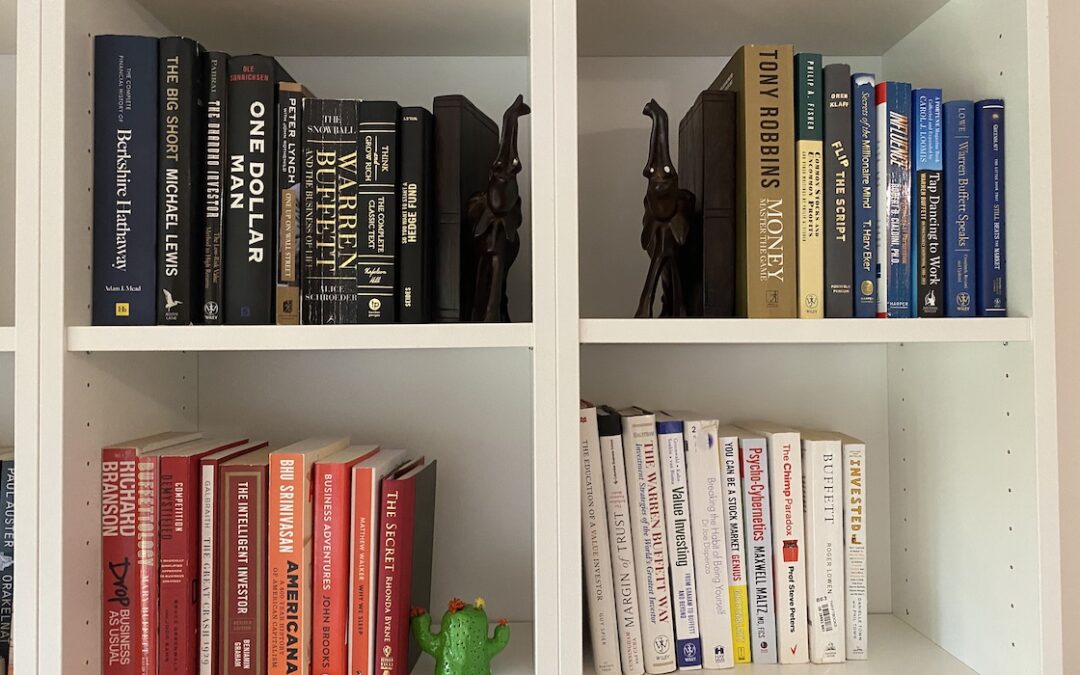
The other day, he shared a picture of his favorite investing books on Twitter (N.B. the picture in this blog post is of my own bookshelf, as I don’t have the rights to use Michael Burry’s picture. You can see his tweet here.).

In this blog post, I will review the books that are on his bookshelf.

1. Securities Analysis by Benjamin Graham

But of course.

This is the bible.

Benjamin Graham went through the crash of 1929 as a portfolio manager.

In 1930, he thought the worst was over and borrowed money – on margin – to invest. He thought he was smart about it and buying at the bottom of a dip, but his fund suffered a loss of 70%.

He outperformed the market, which in the same period fell 80%, but who cares about details like that when you’re suffering: a 70% decline is dramatic and hard to make a comeback from. This meant, among other things, that Ben Graham did not receive any salary from his fund for five years.

That experience led Benjamin Graham – who in addition to running his investment fund also taught classes at Columbia University – to develop a special investment strategy, which today we call value investing.

Securities Analysis is the first and the most.

You can find it here.

He later wrote The Intelligent Investor, which is a slightly more readable version. You can find it here.

2. You Can Be a Stock Market Genius by Joel Greenblatt

There are different kinds of value investors.

Joel Greenblatt is a quantitative value investor.

What do I mean by that?

The quantitative fund managers invest according to certain metrics and key figures, and they invest automatically in a lot of companies.

The qualitative do the opposite. They handpick companies, analyze them carefully as whole businesses and only invest in a few companies at a time. Warren Buffett belongs to this category of investors (and so do I).

With investments in over 1,000 companies, it’s clear that Joel Greenblatt belongs to the quantitative kind (prioritizing automation and quantity over depth and quality).

If you want to know more about that strategy, he is the most well-known living proponent of the method (I say living because Benjamin Graham also invested this way).

You can find You Can Be a Stock Market Genius here.

He has also written The Little Book that Still Beats the Market, which you can find here. It is written for children in an easy-to-understand language.

3. The Making of an American Capitalist by Roger Lowenstein

Michael Burry has repeatedly said that it was Lowenstein’s biography of Buffett that got him on the path of value investing.

This week’s tweet also leads with a tribute to Lowenstein:

“The Making of an American Capitalist by Roger Lowenstein impressed upon me that Buffett is unique, and so must any investor be. Other books on my shelf.”

It’s a really good book. My own is full of handwritten comments, and I still look up stuff in it (for this blog post I looked up how much Benjamin Graham lost after 1929). You learn a lot about investing and Buffett’s style of investing from reading it.

You can find Lowenstein’s book about Warren Buffett here.

4. When Genius Failed by Roger Lowenstein

Roger Lowenstein describes the success and failure of the hedge fund Long-Term Capital Management in this book.

At one point, Warren Buffett actually tried to buy Long-Term Capital Management, which is narrated in Lowenstein’s other book above.

I haven’t read it yet, but I intend to, so not much to say about it yet.

You can find Lowenstein’s book on Long-Term Capital here.

5. All the Devils Are Here by Bethany McLean and Joe Nocera

If you liked The Big Short, this might be a book for you.

It’s about the financial crisis and what led to it.

Bethany McLean likes digging in the dirt. She has also written an eminent book about Enron, which you can find here.

Why should we spend time on the things in history that went wrong, like the financial crisis and Enron? You could argue that those things are over.

But they’re interesting to look at because we want to figure how to avoid them and how to navigate.

I have gone through a long list of bankrupt and fraudulent companies to see if there are any detectable red flags before companies collapse.

Those warnings signs can make a very important checklist that you go through before investing.

Obviously, we want a good return. To get a good return, there is one thing we must be able to steer clear of: the frauds and the bankruptcies. As Warren Buffett says: Rule No. 1 is, never lose money. Rule No. 2 is, remember rule No. 1.

You can find All the Devils Are Here here.

 6. Atlas Shrugged by Ayn Rand

This is actually a fiction book from 1957.

Apparently, it describes a scenario very similar the financial crisis, and therefore the book has made a comeback.

I haven’t read it, but I’m curious about. It’s on my summer reading list now.

You can find it here.

7. Collateralized Debt Obligations & Structured Finance by Janet Tavakoli

With the subtitle New Developments in Cash & Synthetic Securitization.

It’s probably one of the books that helped Michael Burry when he shorted subprime before the financial crisis.

You can find it here.

8. Credit Derivatives by Janet Tavakoli

With the subtitle A Guide to Instruments and Applications.

Michael Burry’s version seems to be the one from 1998. You can find it here.

Janet Tavakoli has also published an updated edition, which you can find here.

9. Structured Credit Products by Moorad Choudhry.

It’s another one of those book that gave Michael Burry specialized knowledge that made it possible for him to see the bigger picture before the financial crisis.  

You can find it here.

10. Three Collections of Buffet’s Shareholder Letters

It’s really nice to see what a big fanboy Michael Burry actually is.

He has all of Buffett’s letters in black leather books. There they stand on the bookshelf, like a priest’s favorite versions of the Bible.

He has three titles:

  • Buffett Partnership Letters 1957-1970
  • Berkshire Hathaway Letters 1977-1990
  • Berkshire Hathaway Letters 1991-2001.

I can’t find the versions that Michael Burry has, but rest assured that you can find these letters online for free.

You can also purchase a collection that runs from 1965-2021 in Kindle version here for less than $4.

I have to admit, I have the Kindle version and I swear by using an e-reader. I have far more books in e-book format than in physical format. The e-reader is easy to travel with (I almost always travel only with hand luggage), and you can read in bed without turning on lights.

If it’s a theory-heavy book, I prefer to have it in a physical format so I can write and underline, and later pull it out and look at my notes. On the other hand, I always miss it when I’m traveling and can’t access it. Some books I have in both versions: physical and e-book.

Like I said: I have Buffett’s letters in e-format, but I’m envious of Burry’s delicious leather-bound editions. 

Warren Buffett’s letters are a kind of highly esteemed bible for any of us.

11. Where Keynes Went Wrong by Hunter Lewis

The book is a discussion of whether Keynes’s financial instruments are still relevant.

I have not read it, but you can do so once you have ordered it here.

12. Financial Warnings by Charles Mulford

How can you detect the warning signs on fraudulent companies?

I love stuff like that, and this book from 1956 is now on my wish list. Unfortunately, it’s difficult to find. Let me know if you find it.

Who would not want to steer clear of the future Enron and Lehman Brothers? I would definitely like to read Financial Warnings, even though it was written over half a century ago.

You can see the book – but not buy it – here.

A Short Seller’s Books

What do I see when I skim Burry’s bookshelf?

There is no doubt that Michael Burry is a real value investor – a true fanboy.

I also see a mind with a focus on disasters and fault detection.

There is a lot of focus on the financial crisis, crashing, cheating and not much focus on how to spot a wonderful company (I would have liked to see at least one book on competitive advantages – or what about Philip Fisher’s classic Common Stocks and Uncommon Profits, which is about asking good questions to find good companies).

These are the books of a highly skilled short seller with one glass eye and one sharp eye on spotting problems.

Don’t forget to read my free e-book that explains my whole investing process – including my favorite way to calculate what a company is worth. You can get it here.


Top 10 Takeaways from Buffetts 2022 Berkshire Hathaway Meeting

Top 10 Takeaways from Buffetts 2022 Berkshire Hathaway Meeting

Every year in early May, over 30,000 shareholders travel to Omaha, Nebraska to hear Warren Buffett and his partner, Charlie Munger, answer questions.

Officially, it’s the annual shareholders’ meeting of Buffett’s company, Berkshire Hathaway.

But that’s not really what it is. As Charlie Munger said, it’s a party. 

And it really is.

People look forward to it. They fly in days in advance, have meetups and dinners, and some even sleep in tents outside the convention center to get the best seat closest to the stage.

Middle-aged men show up in droves to learn about stocks – and about living the second half of life. Young men and women show up to ask about choosing a calling in life or how to be happy.

No question is too big or too small for Warren Buffett. He will answer them all with the same kind respectful attitude.

In this blog post, I’ll give you my 10 takeaways from this year’s meeting in Omaha.

1. There Is Only One Kind of Money

Warren Buffett presented slides with pictures of 20-dollar bills. He explained who had signed it, where it had been printed and what was written on it.

The first note, signed by Rosa Rios, read: “This note is legal tender for all debts, public and private.”

There is nothing coincidental about Warren Buffett sitting and reading the details of a 20-dollar bill aloud.

He explained that while you can go into a See’s candy store and try to buy chocolate with sacks of wheat, technically they might accept it if you bring enough, but money is easier.

However, wheat does not work with the authorities at all.

“Money is the only thing the IRS is going to take from you. It settles debt in the united states,” he said.

What was his point? Doesn’t everyone know that you can’t pay taxes with bags of farm products?

It’s his indirect warning against bitcoin and other cryptocurrencies. He says there is only one kind of money and that it’s the official currencies that are issued by the authorities.

But he also makes another point…

2. Cash is King  

It’s important both for a company and for an individual to have enough cash.

In March 2020, we were really close to seeing a meltdown worse than the financial crisis (if you want to learn more about it, Buffett recommended the book Trillion Dollar Triage by Nick Timiraos).

“If the federal reserve hadn’t done what they did – in my view – in a short period of time, things could have stopped,” Warren said.

In such a situation, it’s important to have enough ready money to be able to pay your bills.

“We will always have a lot of cash on hand. We believe in having cash. There will be a few times in history where, if you don’t have it, you don’t get to play the next day.”

He compared cash to air.

“It’s like oxygen. It’s there all the time, but if it disappears for a few minutes, it’s all over.”

3. Buffett Has Been Busy Buying Stocks, Bigtime

Buffett has been quite active during the first quarter.

On February 26, he said that not much happened. “We just don’t see anything.”

In the first three weeks of the year, they had only bought shares for $ 2.3 billion – mainly buybacks.

“It keeps us away from the bar. It’s something to do,” he said. 

But at the end of February, the market dived, and he got busy.

He spent $ 41 billion in just three weeks in late February and early March.

Among other things, Berkshire Hathaway went on to acquire the investment company Alleghany Corporation, buy a 14 % position in the oil company Occidental Petroleum and buy a 9.5 % stake in the gaming company Activision Blizzard.

He was amazed at it being possible to amass a 14 % stake in Occidental Petroleum in just two weeks.

That could only happen because….

4. The Market Has Become a Giant Casino

When Warren Buffett was a young man honeymooning with Susan Buffett, they passed through Las Vegas, where they met acquaintances from Omaha.

Warren Buffett was surprised that people traveled so far to do something so “mathematically stupid,” as he calls it.

He turned to his young wife and said:

 “I’m going to get very rich. If people are willing to do this… this is a country full of opportunities.”

Warren Buffett says the market, at times, is like a gambling parlor, and we see that happening right now. The market has become a giant casino where people do “mathematically stupid” things.

“Sometimes the market is investment oriented. Other times it’s totally a casino, a gambling parlor. That existed to an extraordinary degree the last couple of years,” Warren Buffett said.

Warren Buffett could buy 14 % of a large company in two weeks only because people trade and gamble as opposed to investing long-term.

“Overwhelmingly, big corporations in America became poker chips,” he said.

Institutional investors in Occidental (like Blackstone) – who do not sell – already own 40 % of Occidental Petroleum. So it really means that Warren Buffett could buy a quarter of the available shares in the market in a short time. Buffett calls that “incredible”.

“It defies anything Charlie and I have seen, and we have seen a lot,” he said.

5. You Don’t Have to Be a Genius to Get Rich From Stocks

When people behave as if the market is a casino, it creates opportunities for Warren Buffett – and for you.

“We depended on mispriced businesses through these mechanisms. We’re not responsible for the mispricing.”

When you invest long-term in a market where people sell on rumors or an analyst’s write-up, opportunities arise.

“We learned a long time ago that it doesn’t take a high IQ. It just takes the right attitude,” Buffett said.

The right attitude is to find wonderful companies at reasonable prices and to keep the investment as an owner – not place it on the table as jeton.

You can read more about how to find wonderful companies in my e-book here.

6. Buffett Never Times the Market

Someone asked Warren Buffett how he has been successful at timing the market.

He doesn’t time anything, he said.

“We don’t have the faintest idea what the stock market is going to do on Monday,” he said.

Which is why Buffett and Munger never act on speculations.

“We have never said or done anything based on what we think the stock market is going to do – or for that matter what the economy is going to do.”

The method is to look at a company and assess whether it is a wonderful company and then find out what it is worth (again, learn more about this method in my e-book here).

“It’s amazing how hard people make how simple a game it is,” he said.

7. How to Make Yourself Inflation-proof

Yes, inflation is here. And it’s been in the cards for a while.

There are 2.2 trillion dollars – or 7,000 dollars per person in the United States – in circulation, according to the balance sheet of the Fed, Buffett explained.

Compare that with 10-15 years ago when that number was just 800 billion.

“When you put a lot of money in peoples hands and there are not a lot of goods, inflation rises,” he said.

Several people asked him how they should protect themselves against inflation. His response was a very simple piece of advice (and he dodged any inflation-proof investing advice).

He said you need to focus on becoming the best at what you do. 

“If you’re the best doctor in town, they’ll bring chickens,” he said.

The point being that your skills are inflation-proof.

“Whatever abilities you have cannot be taken away from you. It cannot be inflated away from you.”.

8. Why Share Buybacks are Great When Done Right

Berkshire Hathaway has very actively repurchased shares since the pandemic began in 2020.

Someone asked in him details about yardsticks for calculating the value of Berkshire Hathaway.

He declined to comment on the calculations.

“There won’t be any formula but a principle, Warren Buffett said.

The principle is that he makes share buybacks when it’s a better investment than buying shares in other businesses.

“We only buy back shares when it’s the most attractive thing to do,” he said (and by the way, Berkshire Hathaway made no share buybacks in April).

He went on to explain a bit about share buybacks. It really only means that as a shareholder, your piece of the company grows.

It’s not much different than if three people run a lemonade stand where one partner sells his part to the other two.

He gave another real life example from his portfolio.

Berkshire Hathaway has not bought shares in American Express since 1998.

Nevertheless, Berkshires stake has grown from 11.2 %. to 20 % since then – exactly because of that: American Express’ share buyback.

“It’s like owning a farm that constantly buys a little more of the neighboring farm,” he said.

The shares must be bought back at the right price though. If too expensive, buying back shares will be value-destroying.

“If you do it at the right price, there is nothing better than buying your own business back,” Buffett said.

9. Buy Productive Assets

Warren Buffett couldn’t help but say a bit more about bitcoin and other cryptos.

He explained that if a person in the audience offered him 1 % of all the farmland in the US, he would buy it on the spot for 25 billion dollars.

The same with 1 % of all apartments in the United States.

“But if you offered me all the bitcoins in the world for 25 dollars, I wouldn’t take it because what would I do with it? I have to sell it back to you one way or the other,” he said.

Farms produce food and apartments give you rent, but bitcoin doesn’t create anything. 

If you owned all sorts of crypto and you couldn’t buy anything in the shops for them, they would be worthless (here we are back to his first point that the IRS only accepts dollars).

“That explains the difference between productive assets and something that depends on the next guy paying you more,” he says.

10. Learn, Let Yourself Be Surprised, and Become a Better Person

Warren Buffett showed the crowd an optical illusion drawing where the black part can represent two profiles looking at each other while the white in the middle can represent a vase – all depending on how you focus on it.

“You can go for years and be lost, and all of a sudden you see something different,” he said.

When he was a young man, learning about value investing was this kind of eye-opener, but he stresses that an eye-popping revelation can happen in any area and at any age.

You can come to a realization about how to become a better person. Or about how to get along with people.

Realizing how to be a better person is a lot more important than having insights about investing, because the second is just money, he said.

“You’ve had a chance to see how stupid you were in all kinds of things you did, why not have the second half of your life be better than the first half,” he said.  

These kinds of discussions are among the best discussions between the two gentlemen’s interaction in Omaha. Like Warren Buffett explained, you’ll only make the second half better if you work at it.

“We have had enough sense to figure out what makes us happy and be somewhat more sensitive to what makes other people unhappy.”

Charlie Munger’s comment to that was: “I don’t even look at what I did when I was younger. It would embarras me.”

Warren Buffett is 92 and Charlie Munger is 98, and they share from their combined 190 years of life experiences.

Buffett said Munger has a simple trick to become a better human being. “Just write your own obituary and reverse engineer it.”

But Charlie Munger said he had an even better trick: Avoid death all together. 

“Just tell me where I’m going to die, and I’ll never go there.” 

Let’s hope they stay away from that place another year so we can meet up in Omaha next year and get even wiser about investing and life.

To download my e-book Free Yourself, click here.


Five Reasons to Let Others Invest for You

Five Reasons to Let Others Invest for You

I’m all about getting educated about money, finance, and stocks and making your own investment decisions.

Sometimes, however, there can be some sound reasons for letting others invest for you instead of doing it yourself.

Over the last four years, I have blogged and made videos and content about making your own investment decisions.

But this week, I took a very important step in a new direction. I got a preliminary yes from 10 partners who are going to let me invest their savings through my new investment firm, Grünbaum Value Invest.

All of them would be able to do it on their own. In fact, 8 out of 10 have taken my 2-month long value investor course.

They are well informed and know how to select wonderful companies and invest in them.

So why do they choose to let me do it instead of doing it themselves? Because it makes sense.

In this blog post, I want to give you the five main reasons that my partners let me manage their money instead of doing it themselves.

1. Too Busy to Get It Done

Some of them have a full-time job, small or large children, a hobby, a house and maybe even a summer house as well.

Some partners would actually like to spend some time researching companies, but they can’t squeeze more time out of the week. It is already a completely juiced lemon.

As one of the new partners said to me:

“I have a baby, and we just bought a house. There’s still a lot of work in the house. I can’t see when I’ll have time to sit down and get it done.”

2. Too Nervous to Handle It Yourself

Warren Buffett says you don’t need to have a very high IQ to be a good investor.

The right mental attitude is far more important. Investing requires a calm mindset.

If you are very nervous when it comes to money, it may be a better idea to remove yourself from the immediate decision of buying and selling.

Money-nervous people tend to buy and sell at the wrong time because they are driven by fear. Fear of losing out and fear of losing.

As someone told me this week, “I get very nervous whether I’m making the right decision. What if the company goes bankrupt? What if all the money disappears? Even the thought of having to pay taxes makes me very nervous.”

This might make some people smile, but it’s no laughing matter to feel this way about money, bills, and investments.

Some people get uncomfortable just paying a restaurant bill. That type rarely becomes good at investing.

3. Need to Focus on Something Else That You Are Building

It’s not quite the same as not having time.

This is about the luxury of reserving your time for something you know you are even better at.

One of my new partners runs a successful business. He told me:

“I want to put my time in the business because that’s where I make my money, and I can make a lot of money there. It makes more sense to put my time there and let you handle the investments.”

4. Not Satisfied With an Average Result

One of my new partners has inherited some money that the bank has managed for the past 20 years. The bank has made a profit from managing the money, but the savings have stalled.

The verdict is very clear.

“It’s quite disappointing,” she says about it.

This comes as no surprise to me. I’ve talked to a lot of people who have been disappointed with the way the bank manages their savings.

They’ll often invest in a mixture of bonds and stocks. The bank clerk will ask the person about their tolerance towards risk, and most normal people will say that they don’t like too much risk because no one likes the thought of losing all their money.

This means that the bank will place a large part of the portfolio in bonds and in a low-interest environment, which is a lousy investment.

Let’s say they get an annual return of 4 percent and charge 2 percent in fees. That means there is only 2 percent left for the investor.

After inflation, this actually means your portfolio is shrinking.

5. You Do Not Want to Own a Bite of the Whole Market

Today’s popular DYI investment advice is to invest in Exchange Traded Funds (ETFs) that follow a stock index.

Following this advice, you will quickly own a small bite of everything.

If you buy a fund following S&P 500, you become a co-owner of 500 US companies.

Few people stop at one ETF, as this passive investing school advocates spreading over many investments.

Most people take this pretty far and buy many different ETFs. That means they end up owning shares in thousands of companies. As a result, they own a bite of the whole market.

It’s like going into the supermarket and saying you want to buy one of each item without looking at what you place in your cart. Do you get black oil, weapons, Russian companies, and companies that use child labor? Yes, you do.

If you want to be a responsible investor, it’s necessary to select your investments, just like a responsible shopper at the supermarket. Turn it over and look at what’s in it. Then look at the price. Is it fair?

Imagine half of the customers in a supermarket automatically bought one of each item in the shop regardless of the price and the quality? What do you think would happen with the prices?

Yes, they’d explode to an unreasonable level because they can sell anything. The index types buy no matter what. That is exactly one of the reasons behind this massive bubble we are in the middle of.

You Can Both Be Informed and Choose to Outsource the Process

If you choose to outsource the process, it doesn’t mean that you aren’t able to be a good investor on your own.

Something surprised me when I had conversations with my partners-to-be. The vast majority of them had taken my 2-month long value investor course.

Of the ten partners in the investment firm, eight are former course participants.

I have taught them how to analyze wonderful companies. Why spend time and money learning about value investing and then leave the decisions to me?

Because that makes the most sense to them, and in fact it’s a win-win situation for all.

As one of the new partners explained:

“I have in no way regretted taking the course. The way you have taught us to analyze a company gives me a feeling of security. I have confidence in the method. I just don’t have the time for it.”

It is a win-win situation to have informed partners.

When an investor is informed about the process of value investing and believes in the method, it means they can sleep peacefully at night.

It’s also a great advantage for the investment company to have informed partners who knows that a dive into the market is a great opportunity to the firm – not a threat.

They will be calm investors who can ask the right question at the right time.

To learn more about my investment method, you can download my book right here.