Bill Ruane’s 4 Guiding Principles to Investing in Stocks

Bill Ruane’s 4 Guiding Principles to Investing in Stocks

How does Bill Ruane – the only investor that Warren Buffett has ever recommended – actually invest?

When Warren Buffett closed his partnership in 1969, he gave his partners two choices.

They could either stay in Berkshire Hathaway, shares that his partnership had purchased, or withdraw cash from the partnership.

For those who chose cash, he recommended that they invest with Sequoia Fund, which Warren Buffett’s former classmate Bill Ruane managed.

Both Sequoia and Bill Ruane were relatively unknown, despite the fact that the fund performed phenomenally.

The fund aimed to beat the S&P index by 4%, and it did much better than that until Bill Ruane’s death in 2005.

The fund invested according to the value investment principles, which are very similar to the approach in my e-book, which you can download here.

In addition to that, Bill Ruane has shared four principles.

The author William Green describes them in the introduction to his recent book, Richer, Wiser, Happier.

What are they?

1. Don’t Borrow Money to Invest

Early in his career, Bill Ruane used leverage to multiply an investment. But when the market turned and crashed, he was hit very hard and had to sell out, and he was almost back to square one.

From that experience, he discovered a painful psychological lesson about investing.

“You don’t act rationally when you’re investing borrowed money.”

Most people think that borrowing money means taking out a loan, but investing on margin will have the same effect.

Most investment accounts let you trade derivatives like options for more than you can cover.

It’s a very stressful situation to discover that you don’t have cash to cover your obligations.

2. Don’t Follow Momentum

Bill Ruane says to be really careful when you see the market going crazy, because people are either in panic or acting on greed and trading certain stocks at unreasonable valuations.

This is his version of the famous Warren Buffett quote, “Be fearful when others are greedy and greedy when others are fearful.”

3. Ignore Market Predictions

A lot of people ask me questions like:

“What do you think will happen in the stock market now? Is it going to turn on Monday?”

Or, “Are we heading into a recession?”

Honestly, I have no clue. Neither does anyone else.

In reality, you need to invest with blinders on.

You need to invest like a horse that focuses on the road in front of it, and you have to avoid getting spooked by passing traffic.

Bill Ruane says, “I firmly believe that nobody knows what the market will do… The important thing is to find an attractive idea and invest in a company that’s cheap.”

Some investors have been able to short and gamble with great success by guessing when the market will turn. The famous investor Bill Ackman shorted the market shortly before the big dip in 2020, and soon after, he plunged back into stocks, betting that it would revert.

He was right, and it was impressive, but in the end predicting the market is based on guesswork.

Others have lost large sums on reading tea leaves.

The most important thing is to focus on finding quality businesses and take them through the check list.

4. Research Well and Focus

Bill Ruane said to invest in a small number of companies that you have researched and analyzed well, so you have informational advantages.

“I try to learn as much as I can about 7-8 good ideas,” he said. And then he plunges in when the price is right.

“If you really find something very cheap, why not put fifteen percent of your money in it?” he said.

However, this advice only applies to those who do the groundwork, get their butt in the chair, and analyze a company.

For the average private investor, index funds may be the best idea. “Most people will be better off with index funds,” Bill Ruane said.

But for those who want to do a little extra to beat the market, it’s a good practice to be thorough and concentrated.

“I don’t know anybody who can really do a good job investing in a lot of stocks except Peter Lynch,” Bill Ruane said.

Bill Ruane was not afraid to put 35% of the fund’s money in a single company like Berkshire Hathaway.

Learn and Be Curious

The writer William Green, who interviewed Bill Ruane in 2001, made his own conclusion based on his conversation with Bill Ruane.

He writes that good investors are intellectual mavericks who are not afraid of defying conventional wisdom.

They think rationally, rigorously, and objectively.

They gather knowledge and always work on improving their way of thinking.

You should do the same.

Read about how others invest. Examine not only the companies, but how the world works.

Be curious.

You can examine my way of investing by reading my e-book, Free Yourself, which you can download right here.


The 12 Investing Books that Made Michael Burry

The 12 Investing Books that Made Michael Burry

Michael Burry, who became famous as an investor when he shorted subprime before the financial crisis, a story which was dramatized in The Big Short, is not a trained economist, and he has never gone to business school.

He is, on the contrary, a trained doctor.

Everything he has learned about stocks and economics, he has learned on his own by reading and investing, and it has made him a phenomenal investor.

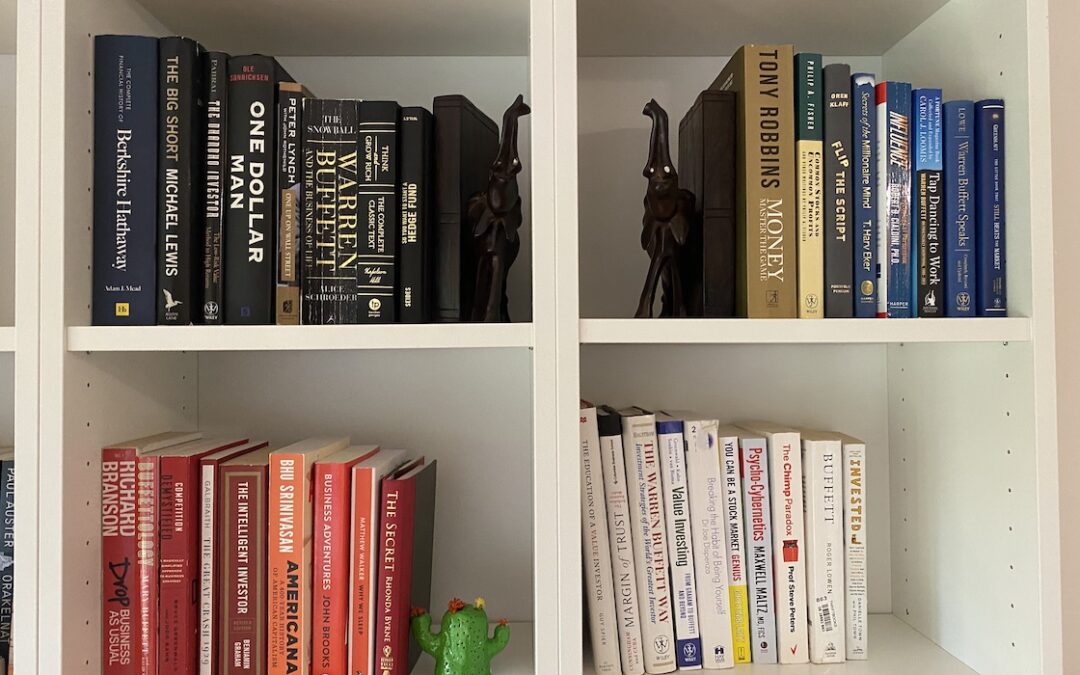
The other day, he shared a picture of his favorite investing books on Twitter (N.B. the picture in this blog post is of my own bookshelf, as I don’t have the rights to use Michael Burry’s picture. You can see his tweet here.).

In this blog post, I will review the books that are on his bookshelf.

1. Securities Analysis by Benjamin Graham

But of course.

This is the bible.

Benjamin Graham went through the crash of 1929 as a portfolio manager.

In 1930, he thought the worst was over and borrowed money – on margin – to invest. He thought he was smart about it and buying at the bottom of a dip, but his fund suffered a loss of 70%.

He outperformed the market, which in the same period fell 80%, but who cares about details like that when you’re suffering: a 70% decline is dramatic and hard to make a comeback from. This meant, among other things, that Ben Graham did not receive any salary from his fund for five years.

That experience led Benjamin Graham – who in addition to running his investment fund also taught classes at Columbia University – to develop a special investment strategy, which today we call value investing.

Securities Analysis is the first and the most.

You can find it here.

He later wrote The Intelligent Investor, which is a slightly more readable version. You can find it here.

2. You Can Be a Stock Market Genius by Joel Greenblatt

There are different kinds of value investors.

Joel Greenblatt is a quantitative value investor.

What do I mean by that?

The quantitative fund managers invest according to certain metrics and key figures, and they invest automatically in a lot of companies.

The qualitative do the opposite. They handpick companies, analyze them carefully as whole businesses and only invest in a few companies at a time. Warren Buffett belongs to this category of investors (and so do I).

With investments in over 1,000 companies, it’s clear that Joel Greenblatt belongs to the quantitative kind (prioritizing automation and quantity over depth and quality).

If you want to know more about that strategy, he is the most well-known living proponent of the method (I say living because Benjamin Graham also invested this way).

You can find You Can Be a Stock Market Genius here.

He has also written The Little Book that Still Beats the Market, which you can find here. It is written for children in an easy-to-understand language.

3. The Making of an American Capitalist by Roger Lowenstein

Michael Burry has repeatedly said that it was Lowenstein’s biography of Buffett that got him on the path of value investing.

This week’s tweet also leads with a tribute to Lowenstein:

“The Making of an American Capitalist by Roger Lowenstein impressed upon me that Buffett is unique, and so must any investor be. Other books on my shelf.”

It’s a really good book. My own is full of handwritten comments, and I still look up stuff in it (for this blog post I looked up how much Benjamin Graham lost after 1929). You learn a lot about investing and Buffett’s style of investing from reading it.

You can find Lowenstein’s book about Warren Buffett here.

4. When Genius Failed by Roger Lowenstein

Roger Lowenstein describes the success and failure of the hedge fund Long-Term Capital Management in this book.

At one point, Warren Buffett actually tried to buy Long-Term Capital Management, which is narrated in Lowenstein’s other book above.

I haven’t read it yet, but I intend to, so not much to say about it yet.

You can find Lowenstein’s book on Long-Term Capital here.

5. All the Devils Are Here by Bethany McLean and Joe Nocera

If you liked The Big Short, this might be a book for you.

It’s about the financial crisis and what led to it.

Bethany McLean likes digging in the dirt. She has also written an eminent book about Enron, which you can find here.

Why should we spend time on the things in history that went wrong, like the financial crisis and Enron? You could argue that those things are over.

But they’re interesting to look at because we want to figure how to avoid them and how to navigate.

I have gone through a long list of bankrupt and fraudulent companies to see if there are any detectable red flags before companies collapse.

Those warnings signs can make a very important checklist that you go through before investing.

Obviously, we want a good return. To get a good return, there is one thing we must be able to steer clear of: the frauds and the bankruptcies. As Warren Buffett says: Rule No. 1 is, never lose money. Rule No. 2 is, remember rule No. 1.

You can find All the Devils Are Here here.

 6. Atlas Shrugged by Ayn Rand

This is actually a fiction book from 1957.

Apparently, it describes a scenario very similar the financial crisis, and therefore the book has made a comeback.

I haven’t read it, but I’m curious about. It’s on my summer reading list now.

You can find it here.

7. Collateralized Debt Obligations & Structured Finance by Janet Tavakoli

With the subtitle New Developments in Cash & Synthetic Securitization.

It’s probably one of the books that helped Michael Burry when he shorted subprime before the financial crisis.

You can find it here.

8. Credit Derivatives by Janet Tavakoli

With the subtitle A Guide to Instruments and Applications.

Michael Burry’s version seems to be the one from 1998. You can find it here.

Janet Tavakoli has also published an updated edition, which you can find here.

9. Structured Credit Products by Moorad Choudhry.

It’s another one of those book that gave Michael Burry specialized knowledge that made it possible for him to see the bigger picture before the financial crisis.  

You can find it here.

10. Three Collections of Buffet’s Shareholder Letters

It’s really nice to see what a big fanboy Michael Burry actually is.

He has all of Buffett’s letters in black leather books. There they stand on the bookshelf, like a priest’s favorite versions of the Bible.

He has three titles:

  • Buffett Partnership Letters 1957-1970
  • Berkshire Hathaway Letters 1977-1990
  • Berkshire Hathaway Letters 1991-2001.

I can’t find the versions that Michael Burry has, but rest assured that you can find these letters online for free.

You can also purchase a collection that runs from 1965-2021 in Kindle version here for less than $4.

I have to admit, I have the Kindle version and I swear by using an e-reader. I have far more books in e-book format than in physical format. The e-reader is easy to travel with (I almost always travel only with hand luggage), and you can read in bed without turning on lights.

If it’s a theory-heavy book, I prefer to have it in a physical format so I can write and underline, and later pull it out and look at my notes. On the other hand, I always miss it when I’m traveling and can’t access it. Some books I have in both versions: physical and e-book.

Like I said: I have Buffett’s letters in e-format, but I’m envious of Burry’s delicious leather-bound editions. 

Warren Buffett’s letters are a kind of highly esteemed bible for any of us.

11. Where Keynes Went Wrong by Hunter Lewis

The book is a discussion of whether Keynes’s financial instruments are still relevant.

I have not read it, but you can do so once you have ordered it here.

12. Financial Warnings by Charles Mulford

How can you detect the warning signs on fraudulent companies?

I love stuff like that, and this book from 1956 is now on my wish list. Unfortunately, it’s difficult to find. Let me know if you find it.

Who would not want to steer clear of the future Enron and Lehman Brothers? I would definitely like to read Financial Warnings, even though it was written over half a century ago.

You can see the book – but not buy it – here.

A Short Seller’s Books

What do I see when I skim Burry’s bookshelf?

There is no doubt that Michael Burry is a real value investor – a true fanboy.

I also see a mind with a focus on disasters and fault detection.

There is a lot of focus on the financial crisis, crashing, cheating and not much focus on how to spot a wonderful company (I would have liked to see at least one book on competitive advantages – or what about Philip Fisher’s classic Common Stocks and Uncommon Profits, which is about asking good questions to find good companies).

These are the books of a highly skilled short seller with one glass eye and one sharp eye on spotting problems.

Don’t forget to read my free e-book that explains my whole investing process – including my favorite way to calculate what a company is worth. You can get it here.


Top 10 Takeaways from Buffetts 2022 Berkshire Hathaway Meeting

Top 10 Takeaways from Buffetts 2022 Berkshire Hathaway Meeting

Every year in early May, over 30,000 shareholders travel to Omaha, Nebraska to hear Warren Buffett and his partner, Charlie Munger, answer questions.

Officially, it’s the annual shareholders’ meeting of Buffett’s company, Berkshire Hathaway.

But that’s not really what it is. As Charlie Munger said, it’s a party. 

And it really is.

People look forward to it. They fly in days in advance, have meetups and dinners, and some even sleep in tents outside the convention center to get the best seat closest to the stage.

Middle-aged men show up in droves to learn about stocks – and about living the second half of life. Young men and women show up to ask about choosing a calling in life or how to be happy.

No question is too big or too small for Warren Buffett. He will answer them all with the same kind respectful attitude.

In this blog post, I’ll give you my 10 takeaways from this year’s meeting in Omaha.

1. There Is Only One Kind of Money

Warren Buffett presented slides with pictures of 20-dollar bills. He explained who had signed it, where it had been printed and what was written on it.

The first note, signed by Rosa Rios, read: “This note is legal tender for all debts, public and private.”

There is nothing coincidental about Warren Buffett sitting and reading the details of a 20-dollar bill aloud.

He explained that while you can go into a See’s candy store and try to buy chocolate with sacks of wheat, technically they might accept it if you bring enough, but money is easier.

However, wheat does not work with the authorities at all.

“Money is the only thing the IRS is going to take from you. It settles debt in the united states,” he said.

What was his point? Doesn’t everyone know that you can’t pay taxes with bags of farm products?

It’s his indirect warning against bitcoin and other cryptocurrencies. He says there is only one kind of money and that it’s the official currencies that are issued by the authorities.

But he also makes another point…

2. Cash is King  

It’s important both for a company and for an individual to have enough cash.

In March 2020, we were really close to seeing a meltdown worse than the financial crisis (if you want to learn more about it, Buffett recommended the book Trillion Dollar Triage by Nick Timiraos).

“If the federal reserve hadn’t done what they did – in my view – in a short period of time, things could have stopped,” Warren said.

In such a situation, it’s important to have enough ready money to be able to pay your bills.

“We will always have a lot of cash on hand. We believe in having cash. There will be a few times in history where, if you don’t have it, you don’t get to play the next day.”

He compared cash to air.

“It’s like oxygen. It’s there all the time, but if it disappears for a few minutes, it’s all over.”

3. Buffett Has Been Busy Buying Stocks, Bigtime

Buffett has been quite active during the first quarter.

On February 26, he said that not much happened. “We just don’t see anything.”

In the first three weeks of the year, they had only bought shares for $ 2.3 billion – mainly buybacks.

“It keeps us away from the bar. It’s something to do,” he said. 

But at the end of February, the market dived, and he got busy.

He spent $ 41 billion in just three weeks in late February and early March.

Among other things, Berkshire Hathaway went on to acquire the investment company Alleghany Corporation, buy a 14 % position in the oil company Occidental Petroleum and buy a 9.5 % stake in the gaming company Activision Blizzard.

He was amazed at it being possible to amass a 14 % stake in Occidental Petroleum in just two weeks.

That could only happen because….

4. The Market Has Become a Giant Casino

When Warren Buffett was a young man honeymooning with Susan Buffett, they passed through Las Vegas, where they met acquaintances from Omaha.

Warren Buffett was surprised that people traveled so far to do something so “mathematically stupid,” as he calls it.

He turned to his young wife and said:

 “I’m going to get very rich. If people are willing to do this… this is a country full of opportunities.”

Warren Buffett says the market, at times, is like a gambling parlor, and we see that happening right now. The market has become a giant casino where people do “mathematically stupid” things.

“Sometimes the market is investment oriented. Other times it’s totally a casino, a gambling parlor. That existed to an extraordinary degree the last couple of years,” Warren Buffett said.

Warren Buffett could buy 14 % of a large company in two weeks only because people trade and gamble as opposed to investing long-term.

“Overwhelmingly, big corporations in America became poker chips,” he said.

Institutional investors in Occidental (like Blackstone) – who do not sell – already own 40 % of Occidental Petroleum. So it really means that Warren Buffett could buy a quarter of the available shares in the market in a short time. Buffett calls that “incredible”.

“It defies anything Charlie and I have seen, and we have seen a lot,” he said.

5. You Don’t Have to Be a Genius to Get Rich From Stocks

When people behave as if the market is a casino, it creates opportunities for Warren Buffett – and for you.

“We depended on mispriced businesses through these mechanisms. We’re not responsible for the mispricing.”

When you invest long-term in a market where people sell on rumors or an analyst’s write-up, opportunities arise.

“We learned a long time ago that it doesn’t take a high IQ. It just takes the right attitude,” Buffett said.

The right attitude is to find wonderful companies at reasonable prices and to keep the investment as an owner – not place it on the table as jeton.

You can read more about how to find wonderful companies in my e-book here.

6. Buffett Never Times the Market

Someone asked Warren Buffett how he has been successful at timing the market.

He doesn’t time anything, he said.

“We don’t have the faintest idea what the stock market is going to do on Monday,” he said.

Which is why Buffett and Munger never act on speculations.

“We have never said or done anything based on what we think the stock market is going to do – or for that matter what the economy is going to do.”

The method is to look at a company and assess whether it is a wonderful company and then find out what it is worth (again, learn more about this method in my e-book here).

“It’s amazing how hard people make how simple a game it is,” he said.

7. How to Make Yourself Inflation-proof

Yes, inflation is here. And it’s been in the cards for a while.

There are 2.2 trillion dollars – or 7,000 dollars per person in the United States – in circulation, according to the balance sheet of the Fed, Buffett explained.

Compare that with 10-15 years ago when that number was just 800 billion.

“When you put a lot of money in peoples hands and there are not a lot of goods, inflation rises,” he said.

Several people asked him how they should protect themselves against inflation. His response was a very simple piece of advice (and he dodged any inflation-proof investing advice).

He said you need to focus on becoming the best at what you do. 

“If you’re the best doctor in town, they’ll bring chickens,” he said.

The point being that your skills are inflation-proof.

“Whatever abilities you have cannot be taken away from you. It cannot be inflated away from you.”.

8. Why Share Buybacks are Great When Done Right

Berkshire Hathaway has very actively repurchased shares since the pandemic began in 2020.

Someone asked in him details about yardsticks for calculating the value of Berkshire Hathaway.

He declined to comment on the calculations.

“There won’t be any formula but a principle,” Warren Buffett said.

The principle is that he makes share buybacks when it’s a better investment than buying shares in other businesses.

“We only buy back shares when it’s the most attractive thing to do,” he said (and by the way, Berkshire Hathaway made no share buybacks in April).

He went on to explain a bit about share buybacks. It really only means that as a shareholder, your piece of the company grows.

It’s not much different than if three people run a lemonade stand where one partner sells his part to the other two.

He gave another real life example from his portfolio.

Berkshire Hathaway has not bought shares in American Express since 1998.

Nevertheless, Berkshires stake has grown from 11.2 %. to 20 % since then – exactly because of that: American Express’ share buyback.

“It’s like owning a farm that constantly buys a little more of the neighboring farm,” he said.

The shares must be bought back at the right price though. If too expensive, buying back shares will be value-destroying.

“If you do it at the right price, there is nothing better than buying your own business back,” Buffett said.

9. Buy Productive Assets

Warren Buffett couldn’t help but say a bit more about bitcoin and other cryptos.

He explained that if a person in the audience offered him 1 % of all the farmland in the US, he would buy it on the spot for 25 billion dollars.

The same with 1 % of all apartments in the United States.

“But if you offered me all the bitcoins in the world for 25 dollars, I wouldn’t take it because what would I do with it? I have to sell it back to you one way or the other,” he said.

Farms produce food and apartments give you rent, but bitcoin doesn’t create anything. 

If you owned all sorts of crypto and you couldn’t buy anything in the shops for them, they would be worthless (here we are back to his first point that the IRS only accepts dollars).

“That explains the difference between productive assets and something that depends on the next guy paying you more,” he says.

10. Learn, Let Yourself Be Surprised, and Become a Better Person

Warren Buffett showed the crowd an optical illusion drawing where the black part can represent two profiles looking at each other while the white in the middle can represent a vase – all depending on how you focus on it.

“You can go for years and be lost, and all of a sudden you see something different,” he said.

When he was a young man, learning about value investing was this kind of eye-opener, but he stresses that an eye-popping revelation can happen in any area and at any age.

You can come to a realization about how to become a better person. Or about how to get along with people.

Realizing how to be a better person is a lot more important than having insights about investing, because the second is just money, he said.

“You’ve had a chance to see how stupid you were in all kinds of things you did, why not have the second half of your life be better than the first half,” he said.  

These kinds of discussions are among the best discussions between the two gentlemen’s interaction in Omaha. Like Warren Buffett explained, you’ll only make the second half better if you work at it.

“We have had enough sense to figure out what makes us happy and be somewhat more sensitive to what makes other people unhappy.”

Charlie Munger’s comment to that was: “I don’t even look at what I did when I was younger. It would embarras me.”

Warren Buffett is 92 and Charlie Munger is 98, and they share from their combined 190 years of life experiences.

Buffett said Munger has a simple trick to become a better human being. “Just write your own obituary and reverse engineer it.”

But Charlie Munger said he had an even better trick: Avoid death all together. 

“Just tell me where I’m going to die, and I’ll never go there.” 

Let’s hope they stay away from that place another year so we can meet up in Omaha next year and get even wiser about investing and life.

To download my e-book Free Yourself, click here.


Five Reasons to Let Others Invest for You

Five Reasons to Let Others Invest for You

I’m all about getting educated about money, finance, and stocks and making your own investment decisions.

Sometimes, however, there can be some sound reasons for letting others invest for you instead of doing it yourself.

Over the last four years, I have blogged and made videos and content about making your own investment decisions.

But this week, I took a very important step in a new direction. I got a preliminary yes from 10 partners who are going to let me invest their savings through my new investment firm, Grünbaum Value Invest.

All of them would be able to do it on their own. In fact, 8 out of 10 have taken my 2-month long value investor course.

They are well informed and know how to select wonderful companies and invest in them.

So why do they choose to let me do it instead of doing it themselves? Because it makes sense.

In this blog post, I want to give you the five main reasons that my partners let me manage their money instead of doing it themselves.

1. Too Busy to Get It Done

Some of them have a full-time job, small or large children, a hobby, a house and maybe even a summer house as well.

Some partners would actually like to spend some time researching companies, but they can’t squeeze more time out of the week. It is already a completely juiced lemon.

As one of the new partners said to me:

“I have a baby, and we just bought a house. There’s still a lot of work in the house. I can’t see when I’ll have time to sit down and get it done.”

2. Too Nervous to Handle It Yourself

Warren Buffett says you don’t need to have a very high IQ to be a good investor.

The right mental attitude is far more important. Investing requires a calm mindset.

If you are very nervous when it comes to money, it may be a better idea to remove yourself from the immediate decision of buying and selling.

Money-nervous people tend to buy and sell at the wrong time because they are driven by fear. Fear of losing out and fear of losing.

As someone told me this week, “I get very nervous whether I’m making the right decision. What if the company goes bankrupt? What if all the money disappears? Even the thought of having to pay taxes makes me very nervous.”

This might make some people smile, but it’s no laughing matter to feel this way about money, bills, and investments.

Some people get uncomfortable just paying a restaurant bill. That type rarely becomes good at investing.

3. Need to Focus on Something Else That You Are Building

It’s not quite the same as not having time.

This is about the luxury of reserving your time for something you know you are even better at.

One of my new partners runs a successful business. He told me:

“I want to put my time in the business because that’s where I make my money, and I can make a lot of money there. It makes more sense to put my time there and let you handle the investments.”

4. Not Satisfied With an Average Result

One of my new partners has inherited some money that the bank has managed for the past 20 years. The bank has made a profit from managing the money, but the savings have stalled.

The verdict is very clear.

“It’s quite disappointing,” she says about it.

This comes as no surprise to me. I’ve talked to a lot of people who have been disappointed with the way the bank manages their savings.

They’ll often invest in a mixture of bonds and stocks. The bank clerk will ask the person about their tolerance towards risk, and most normal people will say that they don’t like too much risk because no one likes the thought of losing all their money.

This means that the bank will place a large part of the portfolio in bonds and in a low-interest environment, which is a lousy investment.

Let’s say they get an annual return of 4 percent and charge 2 percent in fees. That means there is only 2 percent left for the investor.

After inflation, this actually means your portfolio is shrinking.

5. You Do Not Want to Own a Bite of the Whole Market

Today’s popular DYI investment advice is to invest in Exchange Traded Funds (ETFs) that follow a stock index.

Following this advice, you will quickly own a small bite of everything.

If you buy a fund following S&P 500, you become a co-owner of 500 US companies.

Few people stop at one ETF, as this passive investing school advocates spreading over many investments.

Most people take this pretty far and buy many different ETFs. That means they end up owning shares in thousands of companies. As a result, they own a bite of the whole market.

It’s like going into the supermarket and saying you want to buy one of each item without looking at what you place in your cart. Do you get black oil, weapons, Russian companies, and companies that use child labor? Yes, you do.

If you want to be a responsible investor, it’s necessary to select your investments, just like a responsible shopper at the supermarket. Turn it over and look at what’s in it. Then look at the price. Is it fair?

Imagine half of the customers in a supermarket automatically bought one of each item in the shop regardless of the price and the quality? What do you think would happen with the prices?

Yes, they’d explode to an unreasonable level because they can sell anything. The index types buy no matter what. That is exactly one of the reasons behind this massive bubble we are in the middle of.

You Can Both Be Informed and Choose to Outsource the Process

If you choose to outsource the process, it doesn’t mean that you aren’t able to be a good investor on your own.

Something surprised me when I had conversations with my partners-to-be. The vast majority of them had taken my 2-month long value investor course.

Of the ten partners in the investment firm, eight are former course participants.

I have taught them how to analyze wonderful companies. Why spend time and money learning about value investing and then leave the decisions to me?

Because that makes the most sense to them, and in fact it’s a win-win situation for all.

As one of the new partners explained:

“I have in no way regretted taking the course. The way you have taught us to analyze a company gives me a feeling of security. I have confidence in the method. I just don’t have the time for it.”

It is a win-win situation to have informed partners.

When an investor is informed about the process of value investing and believes in the method, it means they can sleep peacefully at night.

It’s also a great advantage for the investment company to have informed partners who knows that a dive into the market is a great opportunity to the firm – not a threat.

They will be calm investors who can ask the right question at the right time.

To learn more about my investment method, you can download my book right here.


Ten Key Takeaways from Charlie Munger’s Daily Journal Talk

Ten Key Takeaways from Charlie Munger’s Daily Journal Talk

A few weeks ago, Charlie Munger answered questions at the Daily Journal’s general meeting, which is an event that many value investors look forward to.

They do so because Charlie Munger – like his friend and partner Warren Buffett – is one of the best stock market investors the world has seen. He is wise and knowledgeable.

Since his speech at the Daily Journal, Charlie Munger has resigned as chairman of the board where he managed the Daily Journal’s investment portfolio for 45 years.

In other words, it was most probably the last time Charlie Munger went on stage to do a Q&A for the Daily Journal investors.

This week’s blog post reflects on his response and gives you the ten most important takeaways from Charlie Munger’s last talk as chairman of the Daily Journal.

But beware, what Charlie says and what Charlie does reveals a mismatch.

1. Munger Views China as a Society of Modern Capitalism

Charlie Munger’s discussion of China is confusing and contains conflicting messages.

The Daily Journal invested heavily in Chinese Alibaba, but recently it has become public knowledge that they sold half of their shares in Alibaba at a loss.

Why the change of heart?

We don’t know yet.

Yet, at the Daily Journal meeting in February, Charlie Munger only gave green signals about investing in China, even though the big divestment had already begun.

What did he say about China?

He is very impressed with how China has fought poverty and created prosperity in 30 years by introducing their own form of capitalism.

“China is a big modern nation. It’s got this huge population and this huge modernity that has come in the last 30 years,” he said.

He praises the agricultural revolution. The Chinese realized that farmers produced 60% more grain if collective farming was abandoned.

“And they just changed the whole system. I greatly admire what they did. I think Deng Xiaoping is going to go down as one of the greatest leaders that any nation ever had. Because he had to give up his own ideology to do something else that worked better,” he says.

2. He Trusts the Chinese Not to Pull the Rug Away

When you buy shares in China, there are some special risks. You’ll probably be investing through ADR (American Depositary Receipts), which means that you only indirectly own shares. There is a risk that the Chinese government can decide that ADRs are not worth anything.

The Chinese government can also decide to nationalize a whole company – they are communists after all – and your investment will go to zero.

To such threats, Charlie Munger responds:

“When you buy Alibaba, you do get sort of a derivative. But assuming there’s a reasonable honor among civilized nations, that risk doesn’t seem all that big to me,”

Whether the war in Ukraine has changed his view of honor between nations, we do not know yet.

3. He Sees a Greater Risk in Getting Stuck in Cash

The US government has been printing money on a large scale since the coronavirus pandemic shook the world.

High inflation has followed.

The risk of losing money due to inflation is a real risk.

“If you hold a depreciating currency, that’s losing purchasing power. On balance, we prefer the risks we have to those we’re avoiding,” says Munger.

It is of course confusing when he says this while simultaneously making a huge selloff of Chinese Alibaba. Why doesn’t he just say that they are selling Alibaba? Because revealing it could make the stock price drop further, make it hard to get rid of and make the Daily Journal lose more money on it.

“We disclose what we have to under the rules because we don’t want people to know what we’re buying and selling. So we tell everybody what we have to under the rules and we keep it confidential until then. That’s our system,” he says.

The clarification will come later. But for now, take note. They are selling Chinese stock, not buying.

4. Crypto Is (Still) Beneath Contempt

Charlie Munger is notorious for speaking out against crypto and calling it “rat poison.”

That is his clear and official position. That hasn’t changed much.

“Well, I certainly didn’t invest in crypto. I’m proud of the fact I’ve avoided it. It’s like, you know, some venereal disease or something. I just regard it as beneath contempt. Some people think it’s modernity, and they welcome a currency that’s so useful in extortions, kidnappings, tax evasion, and so on.”

He adds that he admires the Chinese government for banning it.

On the whole, he seems very impressed with some of the major brushstrokes that the Chinese government can take because it is a totalitarian regime. Whether it’s to introduce a one-child policy or ban crypto.

5. He Proposes a Tax That Would Make It Difficult to Speculate in Stock and Make Short-Term Gains

Some people use the stock market as a gambling den, he says.

There is a contradiction between that and those who try to think long-term and create security for themselves even in old age.

He would make stock less liquid, probably by a higher tax on short-term gain.

“If I was the dictator of the world, I would have some kind of attacks on short-term gains that made the stock market very much less liquid and drove out this marriage of gambling parlor and legitimate capital development of the country. It’s not a good marriage and I think we need a divorce.”

6. He Steers Clear of Any Predictions

He doesn’t try to guess how an index will develop. He focuses exclusively on good investments in individual companies.

“I don’t have any opinion about which index is better at a given time. I never even think about it. I’m always just looking for something that’s good enough to put Munger money in, or Berkshire money in, or Daily Journal money in. I figure that I want to swim as well as I can against the tides. I’m not trying to predict the tides.”

7. He Sees a Bubble, a Drunken Party and Socio-Economic Hangovers

He refrains from making predictions, but he still has an opinion about the overall state of the market and what could go wrong. He believes there is a bubble and an excess that drives it all up.

“Everybody loves it because it’s like a bunch of people at a party having so much fun getting drunk that they don’t think about the consequences. We don’t need this wretched excess. It has bad consequences. You can argue that the wretched excesses of the 1920s gave us the Great Depression and the Great Depression gave us Hitler. This is serious stuff.”

8. He Doesn’t Keep Cash

What does a person do when they see a bubble, great dangers and inflation ahead and they don’t believe in crypto?

What is the answer?

Cash?

Charlie Munger rejects this:

“In my whole adult life, I’ve never hoarded cash, waiting for better conditions. I’ve just invested in the best thing I could find. I don’t think I’m going to change now. The Daily Journal has used up its cash.”

9. The World is Driven by Envy – Not by Greed

There is a huge dilemma: even though people are better off financially, they are not feeling better.

“The world is not driven by greed; it’s driven by envy. So the fact that everybody’s five times better off than they used to be, they take that for granted. All they think about is somebody else having more now and it’s not fair that he should have it and they don’t.”

He says he has conquered envy on a personal level.

“I can’t change the fact that a lot of people are very unhappy and feel very abused after everything’s improved by about 600% because there’s still somebody else who has more. I have conquered envy in my own life. I don’t envy anybody. I don’t give a damn what somebody else has.”

10. Keep It Simple

Many companies and organizations will be more efficient if they trim down.

Generally, there are too many meetings that make it harder to make decisions – not easier.

Companies have become “fat”, and most are more effective on the other side of a serious diet.

“Many places, after they run out 30% of the excess costs, they run better than they did before,” he says. 

He offers the example of Heinz, who has a directors’ table worth 600,000 USD and Costco, who has one worth 300 USD.

“The excess just creeps into these places. Of course, it isn’t good,”

He also snorts at the over-consumption of wealthy individuals.

“Who in the hell needs a Rolex watch so you can get mugged for it?

His advice to young people is simple: “Don’t go there.”

You do not need all those things at all.

“To hell with the pretentious expenditure. I don’t think there’s much happiness in it. But it does drive the civilization we actually have. And it drives dissatisfaction,” he says.

If you want to learn about investing like Charlie Munger, you can download my investment book Free Yourself here.


How Warren Buffett Ran His Early Partnership

How Warren Buffett Ran His Early Partnership

If you invested with Warren Buffett in 1957, and until his partnership was dissolved in 1969, an investment of 10,000 USD would have grown into more than 160,000 USD.

If, on the other hand, you had invested in the US stock index Dow Jones, it would only have grown to a bit more than 25,000 USD.

Warren Buffett began investing for friends and family in 1957, and he got a stunning 25.9% compounded annual return.

This is referred to as the Warren Buffett “partnership.”

How did his partnership work, and what can we learn from it.

What can be copied? What did he do?

Here are the ten most important takeaways.

1. You Can Start Small

In 1956, he set up his first partnership.

The partners consisted of seven friends and acquaintances: his sister and her husband, an aunt, his father-in-law, an old roommate, the roommate’s mother, and Warren Buffett’s own lawyer.

That’s it.

These seven people put in 105,000 USD, which corresponds to about one million in today’s value. Buffett only put in 100 USD.

More partners were gradually added. His old professor Ben Graham closed down his fund and pointed to Warren Buffett as an option.

In early 1957, the different partnerships he ran amounted to 300,000 USD. This corresponds to around 3 million USD today.

What can we learn from this?

It’s fine to start small with friends and family. People will be attracted when you do well.

  1. He Didn’t Have a Track Record

He had studied with and worked for Benjamin Graham, but Warren Buffett had no real track record himself. 

He still had to prove that he was able to manage other people’s money.

Benjamin Graham recommended him, but only one or two took the bait initially because he looked like an 18-year-old kid.

As the money manager Lou Green said at the time (as quoted in Roger Lowenstein’s book Buffett: The Making of an American Capitalist),

“Graham-Newman can’t continue because the only guy they have to run it was this kid named Warren Buffett. And you’d ride with him?”

3. These Were His Terms

One of Buffett’s first outside partners was a urologist named Edwin Davis.

Here’s the deal they cut:

  • Davis, as a limited partner, would get all of the profit up to 4%.
  • The remaining profit would be shared like this: 75% to Davis and 25% to Warren Buffett.
  • Warren Buffett didn’t get any management fee, which was and still is very unusual. A hedge fund today usually takes a 2% management fee of the whole amount and 20% of all profits. This means that Buffett would get no money to cover the costs or nor salary if he didn’t make more than 4%.
  • Davis could only withdraw money once a year – on the last day of the year.
  • Warren Buffett would only make a yearly summary of the result and disclose nothing about how the money was invested.

4. This Was His Goal

Warren Buffett’s target was set relative to the Dow Jones stock index. In the beginning, his goal was to beat the Dow Jones by 10%.

Starting in 1967, when the market was a strong bull market, Buffett became nervous. From then on, he aimed at beating the Dow Jones by 5% or getting 9% in average annual return – whichever he hit first.

5. This is How Well He Did

In his first full year, 1957, he got a return of 10%, while the Dow Jones fell 6%.

I’m curious – so how much did he earn in the first year of investing other people’s money?

The first 4% was “free,” so he only earned 25% of 6% of 300,000.

That means he earned 4,500 USD. In the beginning, running the partnership was not a fat deal.

This is how it went afterwards:

1958: + 40.9% against Dow Jones +38.5%

1959: +25.9% against Dow Jones +19.9%

1960: +22.8% against Dow Jones -6.3%

1961: +45.9% against Dow Jones +22.2%

1962: +13.9% against Dow Jones -7.6%

1963: +38.7% against Dow Jones +20.6%

1964: +27.8% against Dow Jones +18.7%

1965: +47.2% against Dow Jones +14.2%

1966: +20.4% against Dow Jones -15.6%

1967: + 36% against Dow Jones 19%

1968: +59% against Dow Jones 9%

1969: + 7 % against Dow Jones -11 %

If you had invested 10,000 USD in the Dow Jones in 1957, it would have given you a profit of 15,260 USD. If you had, on the other hand, let Warren Buffett invest your savings, it would have given you a return of 150,270 USD – even after Buffett’s pay.

His partnership had an average annual return of 29.5% against Dow Jones 7.4% in the period.

(All data from Roger Lowenstein’s book Buffett – the Making of an American Capitalist)

6. He Was Frugal and Worked From His Bedroom

Warren Buffett was very concerned about keeping the cost of the partnership down.

He did the bookkeeping himself and worked from the family bedroom to save money.

It wasn’t until 1962 that he rented an office and hired a secretary.

Also, Warren Buffett didn’t use many experts.

He probably felt that outside input from experts confused him more than it clarified matters.

He has made major acquisitions without the help of experts. Other funds would conduct due diligence. He did his own due diligence in his mind and settled matters with a handshake.

7. He Educated His Partners

The purpose of the annual letters to his partners seemed to be to keep their interests aligned with his.

As many of the partners were friends, family, neighbors, and acquaintances (plus a growing number of outsiders), the tone was informal.

He spoke to them as one who teaches his disciples. He has said somewhere that he imagined he wrote to his sister.

The original partnership letters are a really worthwhile read even today.

He also invited the partners home for dinners in groups, evenings that the partners looked forward to.

8. His Investment Ideas Were Kept Secret

Benjamin Graham gave all students and co-investors plenty of stock tips, but Warren Buffett didn’t.

He treated his investment ideas as trade secrets.

At one point, he was so secretive that he didn’t even talk about work with his wife Susan.

If a partner showed up at the office unannounced to ask about the investments, they would be thrown out of the partnership.

Just like that.

There were no exemptions.

9. He Saw Stocks as Businesses

He avoided trying to predict how the stock market would do.

He also avoided being influenced by other people’s analyses and opinions.

He analyzed the long-term perspectives of each business – not the stock movements.

He assessed a stock based on whether he would want to own the entire company without being able to sell the stocks again.

He asked himself if he would buy the shares if he were forced to buy the entire business.

He also asked himself whether he would buy the shares if he landed on an island and couldn’t check the stock for ten years.

10. His Portfolio Was Unusual and Concentrated

He sometimes bought entire companies that were not listed on the stock exchange.

This was unusual for a fund manager.

He also invested large amounts in individual companies.

At one point, 40% of the portfolio was invested in one share, American Express.

What about spreading the risk?

Warren Buffett calls diversification “risk management for dummies.” He believes in being thorough and focused.

Knowing what you invest in is better risk management, he says.

Want to learn how to invest like Warren Buffett? Get my e-book right here.